Thursday, July 11, 2013

\Why Twitter Finally Killed The “Auto Follow” For Good

The link to the full story is here


Fresh on the heels of a spam report that painted Twitter as the network with the largest underground economy for the buying and selling of fake followers, the social network has finally taken steps to crack down on one of the tools often used by those attempting to game its service: the Auto Follow. In Twitter’s parlance, an auto follow refers to an immediate and programmatic means of following another user back after they follow you.
There’s an argument to be made on both sides of this issue.
Auto-Following Tied To Spam, Attempts To “Game” The Service
On the one hand, a portion of Twitter’s user base took advantage of auto-following in order to rapidly, and therefore inauthentically, raise their profile and their seeming popularity on Twitter in order to give themselves an air of trustworthiness they would otherwise lack. There are a number of places where you can find lists of auto-following Twitter accounts, which a new Twitter user could follow to quickly build up their “fan base.” (For example here and here.)
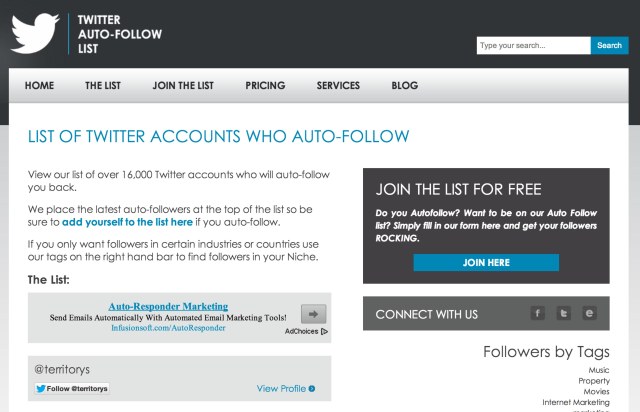
List of Twitter Accounts who Auto-Follow
In addition, several third-party applications previously offered Auto Follow as a service, as it was permitted until late last week through the Twitter API, though it was no longer a feature available directly on Twitter itself. One such service, Twitter Auto Follow Back, even had its own hashtag (#TeamFollowBack) whose junk tweets you may have spotted in your own Twitter stream from time to time. It claims to have handled over 334,000,000 Twitter followers to date.
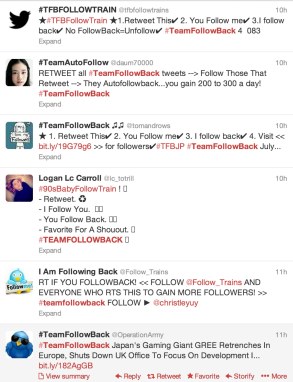
teamfollowbackOthers, like SocialOomph, for example, offer a suite of tools that help Twitter users better manage their accounts, of which Auto Follow was only one option. SocialOomph has since had to overhaul its service to accommodate the new rules. As of today, users will have to manually vet new followers in order to engage with them through other means, including DMs (direct messages) and Auto DMs, the latter of which was oddly not disallowed via Twitter’s API changes, though often more obnoxious to recipients due to their overly solicitous or spammy nature.
“Our system still automatically applies certain user-defined criteria to new followers and only presents those new followers that the user would want to follow-back for manual approval,” explained Patricia Morris on behalf of SocialOomph (via email). “The ‘undesirable’ new followers are automatically excluded, and that automated exclusion is not prohibited by Twitter’s rules.” She also referred to the change as “very shoddy and amateurish behavior of Twitter to spring this rule change as a surprise on developers with absolutely no prior warning or road map.” However, that seems par for the course for Twitter, which routinely sidelines third-party Twitter developers like those offering alternative clients, for example.
Twitter explained the decision to end the Auto Follow as being in the best interest of its users. As noted by a member of Twitter’s Platform Operations team in the comments section of the blog post quietly announcing the news just before the July 4 holiday in the U.S., accounts which engage in the immediate follow-back may find themselves with noisy timelines.
Twitter’s best practices documentation was updated to explain that consequences for abuse going forward will result in the suspension of accounts and applications. Also banned per Twitter’s Rules are the ”get followers fast” applications and services. These, too, recently became the subject of investigation when a New York Times article detailed the practice an estimated multi-million-dollar industry. In the past, there was suspicion that Mitt Romney’s campaign had bought fake followers when his follower count jumped up by around 100,000 in just a couple of days.
This practice, however, has been a common means of establishing a new, high-profile account’s worthiness and authenticity, something Twitter almost necessitated due to its otherwise opaque procedures for having a Twitter account “verified” (i.e. given a seal that indicates the person is who they claim to be).
Where Auto Follow Made (A Little?) Sense
The flip side of the argument against automation is that there are a number of accounts on Twitter that use the service differently than the average user. For example, businesses and brands that want to communicate, market to, or provide support to their customers would often auto-follow their followers so they could better communicate with them privately through direct messages.
This was especially important when a customer wanted to provide the business with personal information like their name, address, phone or email. Though in theory, an immediate return follow by a business may prompt the consumer to engage with a company through a DM, in practice, users tend to simply tweet their questions and frustrations (sometimes not even referencing the business’s Twitter handle) into the air, and then are either surprised by a reply or ignored by the business in question. On the occasion a connection is actually made, the business’s rep still generally has to prompt the user to follow them so they can DM back and forth. This behavior really isn’t impacted by Twitter’s new rules.
Auto Following No Longer In Fashion
According to FriendOrFollow founder Dusty Reagan, the Auto Follow has been on shaky ground ever since the network shut off the feature on its own site back in 2009. (Yes, it used to be native!)
“They also made it clear early-on that automated unfollowing was a risky endeavor. I always kind of felt that auto-follow-back would eventually be against Twitter’s terms of service, so we never included it as a feature in Friend or Follow,” he says.
The practice remained acceptable for some time as high-profile accounts like @britneyspears would attempt to follow all their fans back. But as Twitter grew in size — today it has over 200 million monthly actives — it has become more and more uncommon. Reagan points out that even some of the most heavily followed accounts today only return-follow a small selection of their fans.
While the Auto Follow may have become unfashionable and unsustainable, at the end of the day, the fact that Twitter decided to finally switch off the feature via API is also, to some extent, an admission that its previous spam reporting system has failed. Case in point, one commenter on the Twitter blogpost even suggested a crowdsourced model where users can mark Twitter accounts as being spam as an alternative to switching off Auto Follow — apparently not realizing that the feature hasexisted for years.
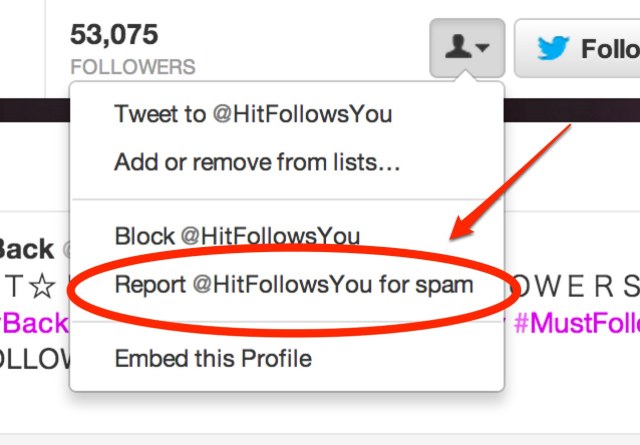
report-spam-twitter
Unfortunately for Twitter, the API changes alone may not be enough to squash spammer activity entirely. Already, this unsavory group has proven itself to have a level of sophistication that at times involves mimicking real user accounts, geo-targeting capabilities, and the promise of multi-year retentions for the fake accounts they sell.
Twitter’s crackdown is merely a Band-Aid on the larger problem with the network’s design: that its users have been taught to value an easily gameable metric like follower count as one of a success, instead of focusing on the quality of a user’s content. That’s not a problem unique to Twitter, of course — it seems to be the nature of social media in general, sadly.

October 2013 Platform Changes Facebook

The link to the full story is here


A year ago we started bundling Platform changes into quarterly migrations. Today, we are announcing the set of changes included in the October 2013 migration, available in the app dashboard today.
The following changes can be enabled/disabled using the "October 2013 Breaking Changes" migration in the app dashboard until October 2nd when they will go into effect permanently for everyone:
Game Achievement API update
Game Achievement action custom properties will appear in the 'data' field, and consistent with other Open Graph Actions.
/USER_ID/likes default update
Currently the API returns all likes by default. After the migration, fetching a user's likes via the Graph API will return 25 results at a time. We've added pagination to the results so you can page through to all of a user's likes.
/POST_ID/likes update
Apps will be able to retrieve all likes on a post (rather than the first 4 as it is today) through paging. As a result of the functionality update, the like count will be moved to the summary field.
Removing 'network' based privacy
As we have deprecated 'network' based privacy settings on Facebook, we are removing the network privacy field from Graph API and FQL. Currently if an app attempts to create a post with a network privacy, it will default to 'only me'. After the migration period, posting with a network privacy will result in an error.
Removing the ability to post to friends' timelines via API
We have found that posting content via API (stream.publish) on a friend's wall lead to a high incidence of user dissatisfaction (hiding content, blocking the app). After the migration period, posting content to friends' timelines via stream.publish will no longer be allowed. Please use the Feed Dialog for posting.
FQL and Graph API limit=0 change
Currently, we have a bug where limit=0 returns all results. After the migration period, specifying a limit of 0 in FQL or the Graph API will return zero results.
The following changes will go into effect on October 2, 2013:
Native iOS and Android apps must use SDKs for login
Native apps on iOS and Android must use our iOS and Android SDKs to initiate Facebook Login. This will provide the best user experience and result in higher conversion. Please see our SDK documentation for details.
Please note: if you are using Apple's Social framework, you may continue to do so, but ensure that if the user is not using the iOS integration, that your app falls back to the Facebook SDK for iOS. This can create more work than necessary, though, so we highly recommend using our SDK instead.
Some developers will receive Dev Alerts in the app dashboard when we detect usage of the changing features. However, we encourage all developers to validate apps with the migration enabled before the effective date to ensure functionality. Please see the Developer Roadmap for more info.

Monday, July 8, 2013

Facebook Graph Search Is Headed to Your Account

The link to the full story is here


Facebook is about to undergo a major change. The company announced July 8 that it's readying to roll out the Graph Search function that it introduced in January and offered in beta form to "tens of millions" of users, who have already helped to improve it.
Graph Search will roll out to everyone who uses "U.S. English" over the next few weeks, said Facebook.
Unlike traditional search tools, Graph Search fetches everything that the user has personally touched or shared or "Liked." These can be links, images, documents or friends. One can search, for example, "friends in my city who like Theophilus London," or, "friends in Florida who voted for Mitt Romney," and Facebook, which has been saving every user's every iota of data since the moment they signed up for its service, will deliver the answers.
If you search "photos of New York City," you'll see photos your friends took and shared, as well as Public photos. The same search will yield different results for different users, given they have different friends.
"We look at this as the third main pillar in our business up to this point," Facebook CEO Mark Zuckerberg said during a Jan. 15 press event, introducing the technology. "We have Newsfeed, for connecting with the people around you. We have Timeline, which tells us the history of the people around you. And now we have Graph Search, which will tie everything together and answer questions directly, in real time."
In its July 8 blog post, Facebook said that since January, the speed of Graph Search has been improved, thanks to early user feedback, and so has "query understanding"—the software now understands more ways of asking a question. It also does a better job of showing the most relevant results first, and the search box has been made easier to see and use.
"As Graph Search rolls out more widely, everyone on Facebook will see a notice on their home page with a reminder about how to control what they share and with whom," the post added. "This follows a similar notice in December that highlighted new privacy tools to help people manage what they share on Facebook."
Days after Facebook's January announcement, Microsoft announced that itsBing search engine was also becoming more socially savvy. Bing's social sidebar now integrates more Facebook data into results.
Bing Program Manager Nektarios Ioannides explained in a May 10 blog post, "Let's say I'm searching for Beyonce tickets. ... I can see that my friend has recently posted that she has an extra ticket to the show. Now, without leaving the Bing results page, I can comment directly to her post letting her know that I'd like to join her for the concert."
Enterprises are also benefiting from the ability to connect people and the information they're closely related to. For example, Telco Telenor is using graph search technology to deliver appropriate services to the right clients in real time, T-Mobile is using it to reply in real time to millions of fans during sporting events, and Glassdoor is using it to link job seekers with opportunities at the organizations their friends and friends-of-friends work at. 
Introducing Graph Search, Zuckerberg called it "one of the coolest things we've developed in a while."

Tuesday, July 2, 2013

Google+ Turns 2, Rolls Out Redesigned Follow Buttons And Badges, Introduces Badges For Communities

The link to the full story is here


Google+ turned two today. To celebrate, Google’s social network didn’t just dress up Mr. Jingles, but it also launched a redesign of its Google+ plugins for websites, including its Follow, +1 and share buttons, as well as its badges for pages and profiles.
All of these are getting a refreshed look, and most of them are also getting a few new features and customization options. In addition, the company is, for the first time, launching dedicated badges for Google+ Communities.
Google will automatically update existing +1 and Share buttons over the next few weeks. Existing badges will be updated in 90 days, which should give website owners enough time to configure the new version for their sites, Google says.
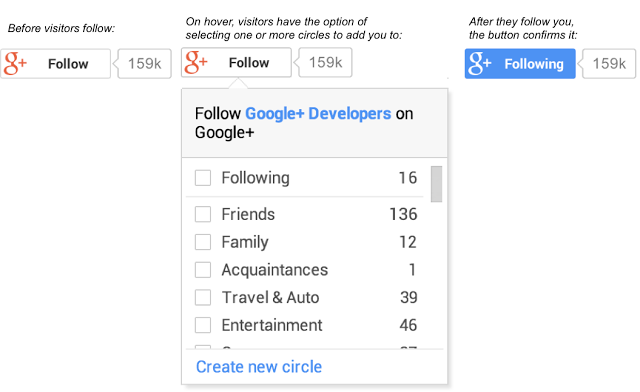
The new visual style, Google argues, is more consistent with its recent redesign of Google+ as a whole. The new look adopts Google+’s cleaner, more minimalist look. The Follow button, Google argues, is now “nice and compact” and should integrate more easily with the social buttons of its competitors.
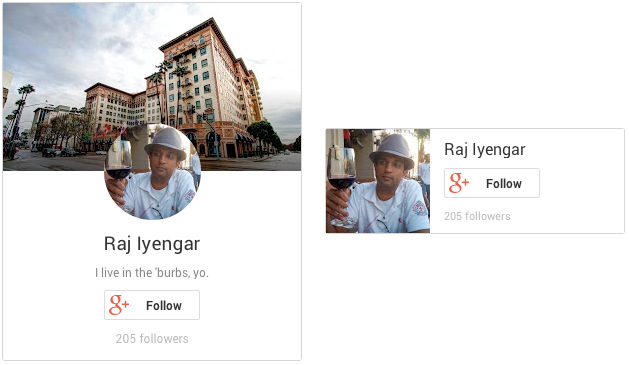
Here is what they look like:
Follow button blog
Page and profile badges are also getting a redesign and can now be used in a light or dark theme and in portrait and landscape mode.
profile badge blog

Google+ Tries To Gain Photo Sharing Ground By Making It Easier To Move, Download, And Upload Your Pics

The link to the full story is here


Photo sharing just got a little better on Google+, as the social network has made it easier for users to move, download and upload their pictures.
Google+ engineering manager Jon Emerson wrote today that the new features came from user feedback.
Users can more easily move batches of photos between albums, use a new download option to quickly save photos and upload large sets of photos faster.
“We hope this latest set of changes makes managing your photos with Google+ easier than ever,” Emerson wrote. “We’ll keep improving Google+ Photos based on your feedback, so please keep it coming.”
A little over a month ago at Google I/O, Google+ launched a revamped and much-improved photo experience. Google+ has impressive functionality and a nice user experience for photos, but is still fighting an uphill battle against Instagram, Flickr, Facebook and others, many of whom have more users interacting with more photos.

Now You Can Browse Twitter’s #Music iPhone App By Genre (And With New Charts)

The link to the full story is here


Twitter released an update to the Twitter #music iPhone app today that should make it easier to explore different types of music.
Previously, you could find different artists in the app through two charts, Popular and Emerging. And Popular was the real focus — that’s where you were taken when you opened the app. Which makes sense, since the goal of Twitter #music is to highlight the music that’s most popular on Twitter.
But if you’re not interested in the absolute top of the charts, the updated app allows you to focus on the types of music that interest you. You can explore Twitter #music based on genres like heavy metal and hip hop, and there are also new charts, specifically Superstars, Unearthed, and Hunted. (Unearthed focuses on “hidden talent found in the tweets” and Hunted highlights “popular music on blogs.” Superstars seems self-explanatory.) And Twitter is highlighting all of the new options by opening the app in a Charts/Genres navigation screen, rather than taking you directly to Popular.
Twitter already added genres and charts to the web version of #music, so this seems like another sign that it’s looking at the website as the place to introduce and perhaps experiment with new features. Other recent additions to the website include a list of an musician’s most-tweeted tracks and similar artists.
Oh, and for Rdio users, the new update is supposed to move the authentication process into the app itself, rather than pushing you out to Safari.

As IPO Nears, Twitter CEO Says “We Think Of Revenue Like Oxygen”

The link to the full story is here


As Twitter nears its IPO — at least according to months of rumors – CEO Dick Costolo seemingly refuses to focus on the money. “We think of revenue like oxygen. Essential to life but not the first thing you think about in the morning,” he told Katie Couric at The Atlantic’s Aspen Ideas Festival. “I don’t try to get caught up in short-term thinking about the company.”
Given the impending IPO, this is likely Costolo’s last interview, so these quotes will haunt them as the $10 billion IPO frenzy ramps up.
Couric asked him if he had learned anything from Facebook’s epic IPO blunder. Costolo, in a transparent dodge that got laughs from the audience, said, “I don’t like to think about reacting to what other people are doing in the market. It’s like driving while looking in the rear view mirror.”
The goal, Costolo said in true buzzword-happy fashion, is to become a “global town square.”
Costolo completely bypassed questions about the National Security Agency’s Internet snooping program. “We have to obey the rule of law,” he said, noting that Twitter was not one of the nine companies named as part of the PRISM program.
It should be noted that Twitter isn’t the only company that claimed to fight the NSA. Yahoo reportedly tried to block the NSA’s spying but lost. So while it’s laudable that Twitter isn’t part of PRISM, it may be because Twitter doesn’t collect the kinds of user identification data most valuable to spy agencies (you can sign up for Twitter with a pseudonym).
Ultimately, Costolo said he wants Twitter to be an interesting place to work. All money and no play makes Twitter a boring business. “That’s not a fun place to go to work in the morning. It’s not particularly innovative.”