Showing posts with label YouTube. Show all posts

Tuesday, January 21, 2014

YouTube Comments Appearing On Google+ Has An Opt Out

I admit this freely. I am a YouTube junkie. As someone who works on a PC 8-10 hours a day I need something extra to keep me going. YouTube is my Red Bull my Five Hour Energy. I listen and sing all day to music from YouTube. And yes, if my walls had ears they would bleed.


After the latest move from Google where they shared what you post on YouTube to your Google+ account, that kinda turned me off from making any posts on YouTube.


Today though I could not help myself and had to post a comment after listening to a song by an non mainstream artist. ( Shameless Plug For That Artist )
When I started to post I noticed a little pop up under the comment field in YouTube that was not there last week.


Notice the check box. The feedback was highly unpopular for Google doing this to begin with. I am glad to see that they gave users the option to NOT SHARE every comment they post.


Kudos Google for making that change.


Monday, December 16, 2013

Google To Boost Advertising Appeal for YouTube, Google Plus

Google is boosting brand advertising appeal for YouTube and Google Plus says Angelina Bouc. All signs point to a significant growth in digital brand advertising. eMarketer advises the growth is expected to explode between 2014 through 2017, in the arena of up to $31 billion spent by advertisers. Currently, digital brand advertising sits at a modest and note-worthy $18 billion annually. Google alone collected over $5 billion in gross revenues for 2013 and is looking to increase that number.


An increase in interest, requires reorganization

To draw advertisers to their doors, Google is promoting a benefit not commonly seen by other platforms. For advertisers, being seen is key, a repetitive dance of “click me, buy me, use me.” Yet, many have faced stumbling blocks in the face of adblockers, which remove any point of contact between viewer and advertiser. It seems Google empathizes with their advertisers pain and decided to bump up one key feature. Advertisers will no longer have to pay for an ad that is purposely blocked by the viewer. Google will gather the information and formulate a price for the advertiser, sans adblockers.

This spark of creative genius could mean placing pressure on companies like Apple to do the same. By allowing the concept of true visual interaction, Google is boosting the brandadvertising appeal for both YouTube and Google Plus. Recently, the largest web search company split its ad business into two different divisions. One is focused on brand appeal, the second focuses on performance ads – calling forth the intrigue of advertisers around the globe. This sort of dedicated business acumen can be seen as a win-win situation for both advertisers and Google.


Digital brand advertising is good business for Google

While the biggest drive is defined on YouTube, Google is also promoting advertising spots with Google Plus and its Android mobile division. Head of sales and marketing for YouTube, Lucas Watson, is excited to embrace the aspect of digital brand advertising. He stated the move to correlate brands and Google is, “enormous” and he expects “massive growth” from the initiation of the digital advertising call-out.

YouTube is such a fundamental part of exposing brand advertising, because the sheer amount of users. More people are turning off their televisions and hitting online streaming. YouTube recently introduced a paid videos avenue, where users can watch some of their favorite movies, by paying a reduced cost. Much like HuluPlus and NetFlix, YouTube will be re-organizing its interface to appeal to advertisers.

In the new year, expect a visual change on YouTube’s site. Google is focusing on redesigning the access of videos, by separating them into genres; such as sports, health, comedy, etc. GroupM Global, the largest buyer of digital media is looking forward to the changes. Its chief digital officer, Rob Norman stated that YouTube will start to resemble “a cable TV line-up,” rather than the current setup, which can seem like a quagmire of videos for many users.

Previous to the changes, Google always held a firm stance against implementing tools like Nielsen’s Online Campaign Ratings. Now to boost their advertising appeal, it seems they are backtracking and opening the door to determine the measure of performance for advertisers. YouTube was once the stomping grounds of fun and interactive video play. It seems the need for advertising is becoming king of revenue and to participate, changes are coming.

From reducing the costs to advertisers if their ad is blocked, to reorganizing the interface, users will start to see a refreshed approach to how YouTube and Google Plus is handled. Google is looking to boost brand advertising appeal for those two outlets, significantly over the next year. The changes can certainly provide a point of serious digital, brand advertising for larger companies. What hasn’t been recognized is the consideration of current viewers and if the changes will start to re-categorize how user uploads are handled. The concept of change is a positive one, especially to compete in the digital market.

Friday, December 6, 2013

Why Twitter Is A Huge Threat To YouTube

This is a great article by Jim Edwards and I agree with Borow on this one. This would be a huge blow to Google if this came to pass. With the IPO not doing so well this would be a large boost to the user community. Read the article below.

Google ought to be very afraid of the threat Twitter presents to YouTube, I was told recently over lunch with James Borow, CEO of SHIFT, a social media marketing company. (SHIFT is one of Twitter's early advertising partners, and its clients include American Express, Toyota and Walmart.)


This didn't make much sense to me.

I pointed out to Borow that Twitter doesn't host its own videos, and that YouTube doesn't allow people to tweet.

Perhaps he was confused.

But then Borow made this argument:

People use Twitter as their default "public" identity, especially in the media. Athletes, celebrities, and news anchors all ask you to follow them on Twitter, not on YouTube. (You can follow them on Facebook too, of course, but the minimalist nature of Twitter seems to make it a less risky place for sharing.) If you're a fan of Kay Perry or CNBC's Melissa Lee, it's a lot easier to wait for them to tweet stuff at you than to follow them anywhere else — YouTube or CNBC — where you'd have to repeatedly check for new postings.

Currently, YouTube is benefiting from this arrangement, because media people host their videos on YouTube and then tweet the link on Twitter. The two brands are symbiotic.

But recently, Twitter began stealing short-form video content from YouTube in the form of Vine, with its 6-second blasts. (Instagram is another threat to YouTube, with its 15-second grabs). If you want to show people a very short video, then YouTube is no longer the easiest or most obvious place to put it.

For this reason, Borow believes Twitter will begin hosting its own videos, of all lengths, simply because following a person on Twitter creates a "channel" for new video. YouTube has tried to create popular video channels in the past, but they haven't really caught on. Most people discover video on YouTube from links or embeds elsewhere on the web, or through search. YouTube, right now, is like a back-end video-serving database for user-facing channels like Facebook and Twitter.
"Twitter will be the main host of video content in the future," Borow believes.


The other advantage Twitter has over YouTube is an "identity layer." Twitter users are logged in. Twitter and its advertisers know who you are, and how to target you with relevant ads. On your phone, the ID is even stronger because Twitter users are logged in permanently. And you're giving away your phone number. Sure, you could look at Twitter without being logged in, but it doesn't work as well. In fact, Twitter has a good business in non-logged in traffic. More people see Twitter content from the "outside" as monthly unique visitors in the U.S. (62.6 million) than there are U.S. monthly active users of Twitter (about 50 million).

YouTube is 90% functional without the need to login, even though Google is trying to encourage more logins. So the identity part of YouTube is much weaker than Twitter.

So Twitter has a triple advantage over YouTube when it comes to video:
It's better at organizing it into channels.
It's better at publicizing it to fans.
And it's better at identifying those fans to advertisers.

"YouTube will be very, very scared" the day Twitter announces it can host all types of video, Borow believes. It won't happen soon, he cautions. Video hosting requires a big buildout of new servers. It's not easy. "It's a huge infrastructure cost. But eventually they will," Borow believes.

Twitter will also need to improve its search function, which right now is terrible. Search on YouTube and Google for video is very high quality.

So YouTube has some time to deal with the threat. But if it doesn't, Twitter will be there, stealing YouTube's business out from under it. "They become really pretty amazing" with video, Borow says.

Tuesday, December 3, 2013

Youtube makes a comment on the new integration with Google Plus

Since we launched the new comments experience on YouTube two weeks ago, we’ve received a lot of feedback from creators on the increase in comment spam. While the new system dealt with many spam issues that had plagued YouTube comments in the past, it also introduced new opportunities for abuse and shortly after the launch, we saw some users taking advantage of them.


We’ve worked hard to combat the increase in spammy comments and have made a number of updates, including:

Better recognition of bad links and impersonation attempts
Improved ASCII art detection
Changing how long comments are displayed


We know the spam issues made it hard to use the new system at first, and we’re excited to see more of you getting involved as we’ve fixed issues. New features like threaded conversations and formatted comments are coming to life, thanks to you and your fans.


So what's next? We're moving forward with more improvements to help you manage comments on your videos better. Bulk moderation has been a long standing creator request and we'll be releasing tools for that soon. At the same time, we’re also working on improving comment ranking and moderation of old-style comments.


Thanks for sticking with us.


Hopefully they will forgo this idea and move on. But with the real money coming from social network advertising I HIGHLY doubt they will.

Tuesday, November 12, 2013

Google Integration Of YouTube Comments On Google Plus Not Popular

This is a bad move by Google. To force the comments made on Youtube onto your Google+ page is ridiculous. It would appear I am not alone in this matter. Christopher Zara reports that the backlash against Google Inc. (NASDAQ:GOOG) is mounting over its decision to integrate YouTube comments with its Google+ social network.

Just days after a YouTube founder criticized the move, angry Reddit users descended on a Google products forum to express their dissatisfaction, saying they don’t want Google shoving its social network down their throats.

The Reddit incursion began Sunday after a Reddit user posted a direct link to the forum, encouraging fellow Redditors to post complaints about the forced integration. Within hours, the link moved up to Reddit’s front page, and hundreds of thousands of users had aired their grievances. As of Monday morning, the forum had more than 429,000 posts and counting. Chief among the complaints was the loss of anonymity that goes along with being forced to use a Google+ account to comment on YouTube videos.

“I have built up a small following on YouTube and I prefer to keep that persona as-is,” one user wrote. “I don’t want those followers peeking into my personal life. That’s the beauty of it, I COULD have a second identity.”

Other Redditors -- many others, in fact -- saw the integration as a thinly veiled attempt to stronghold Google+ holdouts into creating accounts, thereby relinquishing yet one more tier of privacy to the Silicon Valley behemoth. “Stop trying to ram your own data-mining crap down my throat,” one user posted.

The crux of the grievances stem from the perception that Google is desperate to make inroads in the social space, an effort to compete with the likes of Facebook Inc. (NASDAQ:FB), Twitter Inc. (NYSE:TWTR) and LinkedIn Corp. (NYSE:LNKD). Similar complaints were lodged at Google in March after it killed off its Google Reader RSS service. Google has, on occasion, touted the growth of its social network -- last month it said the site is up to 540 million active users. But many tech journalists remain skeptical, pointing out that “active” users could mean someone simply watching a YouTube video or clicking the red indicator that appears on the top-right of their screen.

Google, which announced the YouTube-comment change in September, said in a blog post that it is simply trying to make YouTube comments more relevant and conversational.


“When it comes to the conversations happening on YouTube, recent does not necessarily mean relevant. So, comments will soon become conversations that matter to you. In the coming months, comments from people you care about will rise up where you can see them, while new tools will help video creators moderate conversations for welcome and unwelcome voices.”

The move comes at a time when more and more websites are debating the value of anonymous comments, saying they foster an uncivil atmosphere. In the case of YouTube, where 100 hours of video are uploaded every minute, Redditors say a little incivility is far more preferable than the alternative. “Why in the world would I want to use my full name on YouTube?” asked one. “Unless my name was literally John Doe I don't want some random potential murderers/rapists/Nazis able to track me down based on my YouTube content.”

Thursday, July 25, 2013

YouTube Launches Embeddable Off-Site Subscribe Buttons To Boost Channel Subscriptions

The link to the full story is here


Over the last few years, YouTube slowly started putting a larger emphasis on channels — especially channel subscriptions — but until now, the only way to subscribe to a channel was on YouTube itself. Today, however, YouTube is changing this with the launch of a set of embeddable subscribe buttons that video creators can put on their websites. These buttons are now available for free and paid YouTube channels.
YouTube obviously hopes that these buttons will get more users to subscribe to channels in general. Chances are, the company also hopes that this will boost subscription rates for paid channels, which have been off to a slow start.
Making one of these buttons just takes a few seconds. All you have to do is insert your channel’s name here, copy and past the code into your website and you’re good to go. You can choose between very basic buttons and those that feature both your channel’s name and logo (with a white or dark background).

Monday, May 20, 2013

YouTube Turns Eight As Platform Surpasses More Than 100 Hours Of Video Uploaded Per Minute

The link to the full story is here


YouTube turns eight years old today, reminding each of us in some odd way how young or old we really are. Remember, the company launched back in 2005, the same year that Michael Jackson was found not guilty of child molestation, and Lance Armstrong was winning his seventh Tours De France, and Arrested Development was still on the air.
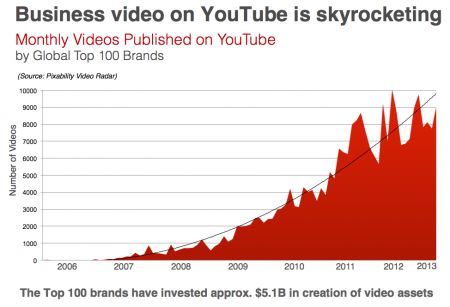
A lot has changed since then, but YouTube’s growth remains strong as ever. YouTube announced that its community now uploads more than 100 hours of video to the platform every minute. Minute. That’s the equivalent of four days worth of video every sixty seconds.
But of course, the supply makes sense when you consider the demand. YouTube claims that more than one billion people across the world come to YouTube for content each month, which comes out to nearly one in every two people who have access to the internet.
Here’s a little perspective on growth: Two years ago, YouTube revealed that users were uploading 48 hours of video each minute, and last year it had grown to 72 hours. Eight years in, YouTube is still a growing platform, while Facebook may be slipping amongst younger and fresher social niche applications.
Meanwhile, YouTube opens up new possibilities for startups who want to leverage its massive, active user base and content library. Telecast, in particular, comes to mind, as the betaworks company helps makes all those billions of videos discoverable and curated on mobile devices.

Monday, May 13, 2013

YouTube Tiptoes Toward Paywalls With The Launch Of Channel Subscriptions, But The Ads Play On

The link to the full story is here


While it would take you a million lifetimes to watch all the video on YouTube, the company relies on contributions from its amateur and professional partners to keep its content fresh. At the same time, its core business model revolves around providing advertisers with the ability to reach its billion-plus viewers. In turn, video creators rely (or want to rely) on a piece of that ad revenue to continue producing their content. The problem is, of course, that those ads are intrusive, annoying and, at the end of the day, its partners are finding that the revenue from those banners and clips isn’t growing nearly as fast as, say, the number of cat videos on YouTube.
In an effort to provide its partners with an alternative revenue stream, YouTube announced today that it is officially launching a pilot program that enables its video stars to charge subscription fees for access to their channels. Subscriptions will start at $0.99/month, and every channel will be able to offer a 14-day free trial, along with discounted yearly rates.
In its announcement, YouTube cites Sesame Street, which will offer full episodes through its paid channel, and UFC offering fans the ability to watch classic fights as examples. For more, here’s the list of its 53-odd pilot channels.
As of today, users can subscribe to paid channels from their desktops and laptops and watch across devices, but going forward YouTube will look to add the ability to subscribe from any medium/device. On top of that, YouTube will begin a broader roll out of subscriptions in the next few weeks for “qualifying partners,” and from the looks of it, it will be adding a paid channel recommendation feed — just as it does now for free channels.
If you don’t have a YouTube channel, why should you care? Well, YouTube has been telegraphing this for awhile, but it’s really the first (official) sign that YouTube is beginning to tiptoe into the paid video market. Granted, the subscription model isn’t a new idea for YouTube, considering the company just announced in March that it will be launching a music subscription service later this year.
The goal is much the same: Give musicians/artists/creators an opportunity to make some money, while improving the user experience for listeners by potentially removing some of those obnoxious ads that start every video. Of course, in the case of both video and music, it’s much more likely that YouTube is going to stick with both.
Amateur content creators are going to be hesitant about erecting paywalls around their content. Most viewers are going to balk at the idea of buying a subscription to a YouTube channel, and there’s a question of whether or not they’d really be able to convert enough of their viewers to paid subscriptions to make it worth it. In the end, it’s the same issue newspapers and publishers have struggled with for years.
There’s also the fact that every video producer is already offering their content for free, although behind ads. Now you’re going to tell viewers that they have to pay for the same content they’ve been getting for free? Sure, that will work for your superfans, but as is the way with the “freemium” model, if you’re going to charge, the content behind the paywall better be, well, premium. I want to see “Extras,” exclusive content/footage, and so on.

Monday, April 8, 2013

YouTube Signs Major Music Deal With Universal

The link to the full story is here


YouTube's takeover of the pop music landscape appears to be going global.
Music Weekly reported Wednesday that France's Society of Authors, Composers and Publishers of Music (SACEM) and worldwide publishing powerhouse Universal Music Publishing have both reached international agreements with YouTube, the newest power player in the major music market.
The agreement allows for YouTube to distribute music published by SACEM and UMP to 127 new countries throughout Europe, the Middle East, Asia and Africa, a move that will boost YouTube's musical presence and make it easier for publications like Billboard Magazine, which recently began factoring YouTube plays into its Billboard Hot 100 charts, to better realize what's popular throughout the world.
"SACEM is proud to be the first authors' society in the world to have signed an agreement of this scale with YouTube, the world's leading digital platform of music videos,” said SACEM CEO Jean-Noël Tronc. “This contract bears witness to our commitment to increasing both the visibility of works and the remuneration of our members, and of those of our partner UMP, with a major internet service, YouTube, the number one vector for discovering works on the internet."
UMP chairman and CEO Zach Horowitz offered much of the same, adding that "the digital market can only flourish if creators receive fair remuneration delivered through efficient and innovative licensing solutions."
The news comes six weeks after Billboard reported UMP was climbing into bed with two major YouTube networks, Maker Studios and Fullscreen, Inc., an agreement that allows for YouTube's content creators to use UMP's content in videos, with the publishing company recouping an undisclosed percentage of revenue from ads that run alongside those videos.
It also arrives 10 weeks after news broke that YouTube was nearing a renewed deal with Vevothat could be worth as much as $50 million. The music video streaming site, the largest on the Internet, is co-owned and operated by Universal Music Group in tandem with Sony Music Entertainment.
One country that won't be affected by the agreement is Germany. The European nation's largest music royalties collection agency, GEMA, has been at odds with the video sharing site since April 2009, and recently broke off all negotiations over proper royalty rates and tenets concerning intellectual property and copyright law.
YouTube did not respond to the Daily Dot's request for comment on the GEMA dispute.

Monday, March 25, 2013

YouTube Now Has One Billion Monthly Users

The link to the full story is here


We all know YouTube is the biggest video sharing site around, but how big is it, exactly, when compared to sites such as Facebook or Twitter? Here's a hint: YouTube has just hit one billion monthly unique users.
For comparison, Facebook hit that milestone in October 2012. It took the social network eight years to reach one billion active users — almost the exact amount of time as YouTube, which was founded in February 2005. Twitter, which has been around since March 2006, has more than 200 million monthly active users.
The YouTube team gives us a few more comparisons for good measure: "Nearly one out of every two people on the Internet visits YouTube. Our monthly viewership is the equivalent of roughly ten Super Bowl audiences. If YouTube were a country, we’d be the third largest in the world after China and India," says YouTube on its official blog.
YouTube also gives a more detailed insight on what's powering this growth in another blog postabout Generation C and mobile devices. According to YouTube, Generation C (or Gen C) is a generation that has grown up consuming content "where and when they want". They watch YouTube on all screens; they constantly switch between devices, they're deeply engaged with online video and they thrive on community. Finally, they're curators — they care about finding content that's important to them.
Gen C, which YouTube considers to be its core audience, now watch just as much YouTube content on smartphones as they do on PCs, and 67% of Gen C watch YouTube on two devices or more, compared to 53% of the general population.
With the rise of smartphones, which have become the dominant force in the mobile phone industry in the last couple of years and show no signs of slowing down, YouTube needn't worry about maintaining this growth for at least another couple of years.

Monday, March 18, 2013

YouTube Capture Comes To iPad

The link to the full story is here


YouTube Capture is now available for iPad and iPad mini. The app, which originally launched for iPhone in December of last year, lets you record videos and instantly upload them to YouTube.
If your video needs a little sprucing up, the app has color correction and stabilization options built in. You can also trim up a particular clip, or add a music track to your finished product.
Finished videos can be uploaded to YouTube as either a private or public video. If you want to really go public, those videos can also be instantly shared to Facebook, Twitter and Google+.
YouTube Capture for iPad is available now from the App Store.

Wednesday, March 6, 2013

YouTube To Launch Music Subscriptions

The link to the full story is here


YouTube plans to launch a music subscription service later this year, to allow people to listen to tracks online, and to possibly cut out the ads that precede each video for subscribers, according to Fortune.

The largest storehouse of streaming video, YouTube relies on selling banner ads on the site and running short clips before each video, giving a cut back to record companies.

YouTube has released a statement that confirmed it was considering a subscription service, but noted that ads wouldn’t go away:

While we don’t comment on rumor or speculation, there are some content creators that think they would benefit from a subscription revenue stream in addition to ads, so we’re looking at that.

YouTube stepping up the game as a music provider sense to me. It’s is one of the first places I hit up when I’m looking to listen to a new track quickly. Sure, it’s not often the best quality, but it’ll do in a pinch. A proper subscription service is likely to provide higher fidelity tracks, and elevates YouTube to the same playing field as labels such as Warner Music which do rely on streaming revenue.

Google already has partnerships with numerous music publishers. Last November, it struck up a deal with Armonia, one of the largest alliances of music publishers, giving it access to 5.5 million tracks across 35 countries.

And in the larger scheme of things, the company might overlap its new subscription plans into its Google Play music service. In December, it rolled out a free “scan and match” feature that allows users to add up to 20,000 songs from their offline collections to the Google cloud and stream it to their devices on the go.

Wednesday, February 27, 2013

YouTube App Update Suggests Paid Channels Are on the Way

The link to the full story is here


Code found in YouTube’s most recent app update suggests that Google may be working on pay-to-view channels.

Spotted by Android Police, the code mentions subscribing and unsubscribing from paid YouTube channels, a function that will apparently only be available on the web, not in YouTube’s mobile app.

Rumors have circulated for some time that Google was considering paid channels on YouTube; the stray code in the app update all but confirms that rumor.

In January, AdAge reported that Google had reached out to a small number of channel producers, asking them to submit applications and create channels that users would have to pay to access, in most cases to the tune of $1 to $5 per month.

In response to the AdAge story in January, a YouTube representative told Mashable, "We have long maintained that different content requires different types of payment models. The important thing is that, regardless of the model, our creators succeed on the platform. There are a lot of our content creators that think they would benefit from subscriptions, so we’re looking at that."

The company has previously discussed the possibility of offering pay-to-view channels as a way for television networks to continue to broadcast shows that might not be bringing in enough cash to exist on cable networks but have a passionate and dedicated audience.

Thursday, January 31, 2013

Twitter Brings Large, Lightboxed Photos To The Web, Adds Video From Vine, YouTube And More To Media Galleries

The link to the full story is here


Twitter has announced a couple of updates for its web service today, designed around media sharing. There’s a new interface for viewing photos, which provides a larger look at pictures without forcing users to leave the page thanks to a lightbox overlay, accessible when you click a photo from a profile page or in search results. And video from Vine, YouTube, Vimeo, and any other partner whose movie clips show up in expanded tweets now also shows up in a user’s media gallery alongside photos.

Also new is an improved conversation view, which lets you see all of the replies to a Tweet by scrolling down. You can see it in action on this call-out from Jimmy Fallon, which also illustrates its best uses. Brands and media entities will likely love this feature, since it provides a better way to not only keep track of Twitter conversations, but also should promote more engagement and conversation branching among users.

The addition of video to media galleries is a logical next step for Twitter, especially following the launch of Vine. Truth be told, it’s likely they wanted to be able to highlight all that new user-generated content somewhere on Twitter itself, but it’s nice to see them extend that courtesy to other video partners as well.

Wednesday, January 30, 2013

YouTube to Launch Paid Subscriptions

The link to the full story is here


It looks like YouTube is about to take a big step towards monetizing its videos.

YouTube is planning to launch paid subscriptions for a couple dozen channels as soon as April, according to a new report in AdAge citing "multiple people familiar with the plans."

The online video site has reportedly reached out to a "small group" of channels asking them to apply to be among the first paid channels. There is also talk that YouTube might charge for live events like concerts and libraries of older episodes.

AdAge reports that the initial subscription costs would be between $1 and $5 per month. These channels would also have the option to show ads.

Right now, this effort is being billed as an "experiment," but it's one that YouTube reps have been suggesting for a long time. YouTube's CEO Salar Kamangar teased the idea multiple times last year and noted during the Reuters Media and Technology Summit in June that it had "seen demand from from the kind of networks that have smaller audiences on cable."

By effectively launching a-la-cart and pay-per-view options for consuming video content, YouTube would likely bring in more money from ad dollars and a cut of the subscription revenue.

Thursday, January 17, 2013

YouTube said to be investing cash in Vevo

The link to the full story is here


YouTube was supposedly courting Vevo last May and is now reportedly ready to make an investment, according to AllThingsD. If indeed the video giant does partner with Vevo, the way consumers view content on the site will supposedly stay the same -- which means watching big label music videos for free.
Vevo was tallied as the third most-watched video site in the U.S. last May, with 49.5 million viewers per month, according to ComScore. No. 1 was Google, with 157.7 million viewers, largely through its YouTube operation, and second was Yahoo. YouTube helped create Vevo's back end, and Vevo's videos are best known for appearing on YouTube.